
“Nasha mukti kendra” is not a type of licence. It is a common name that very different places use, from government de-addiction centres and NGO-run centres to private medical rehab centres, and sometimes unregistered hostels with no doctor at all. So the real difference is not what a centre is called. It is whether there is medical detox, qualified doctors and therapists, registration under the law, respect for the patient’s consent, and a plan for life after discharge.
Families searching for help often see both terms side by side: “nasha mukti kendra near me” and “rehab centre near me”. In Gujarat you will also hear vyasan mukti kendra. This guide explains what each term really means, the four kinds of centres you are likely to come across, what Indian law requires, and how to tell a safe centre from a risky one.
What Does “Nasha Mukti Kendra” Actually Mean?
Nasha mukti means “freedom from intoxication”, and kendra means “centre”. The phrase describes a purpose, not a standard of care. A government hospital ward, a charitable centre and a fully staffed private rehabilitation centre can all call themselves a nasha mukti kendra.
“Rehabilitation centre” or “rehab centre” is the more clinical term. It usually means a residential programme that combines medical detox with therapy and recovery planning. But the name alone doesn’t guarantee that either. Some centres called “rehab” offer very little treatment, and some called “nasha mukti kendra” offer excellent care.
What Kinds of Centres Will Families Come Across?
Behind the names, most centres in India fall into one of four groups.
1. Government de-addiction facilities
Under the national action plan for drug demand reduction (NAPDDR), the Ministry of Social Justice and Empowerment supports Addiction Treatment Facilities in government hospitals and District De-Addiction Centres. In February 2024 there were 83 such hospital facilities and 53 district centres across India. They are medically run and free or low-cost, and they suit families who need urgent, safe detox. Waiting times, shared wards and limited one-to-one therapy are the usual trade-offs.
2. NGO-run centres supported by the government
The same scheme funds non-governmental and voluntary organisations to run Integrated Rehabilitation Centres for Addicts (IRCAs). There were 342 IRCAs in February 2024. Many families know these as their local nasha mukti kendra. Costs are low or subsidised, but quality varies from centre to centre, so it is worth visiting and asking questions.
3. Private rehabilitation centres
Private centres are paid for by families, and they offer residential treatment that usually includes medically supervised detox, psychiatric care, individual and group therapy, family counselling and relapse-prevention planning. They vary widely in price and quality. Our guide to the cost of a rehabilitation centre in Gujarat explains the fee ranges and what the fee should cover.
4. Unregistered centres
Some places use the name “nasha mukti kendra” without being registered, and without doctors or trained counsellors. News reports regularly describe police and health officials rescuing people from such centres. In February 2025, for example, police in Dabwali, Haryana rescued 29 people from an unauthorised centre where, they said, there was no medical supervision and residents were kept against their will. These centres are often cheap, and that is exactly why families should check carefully.
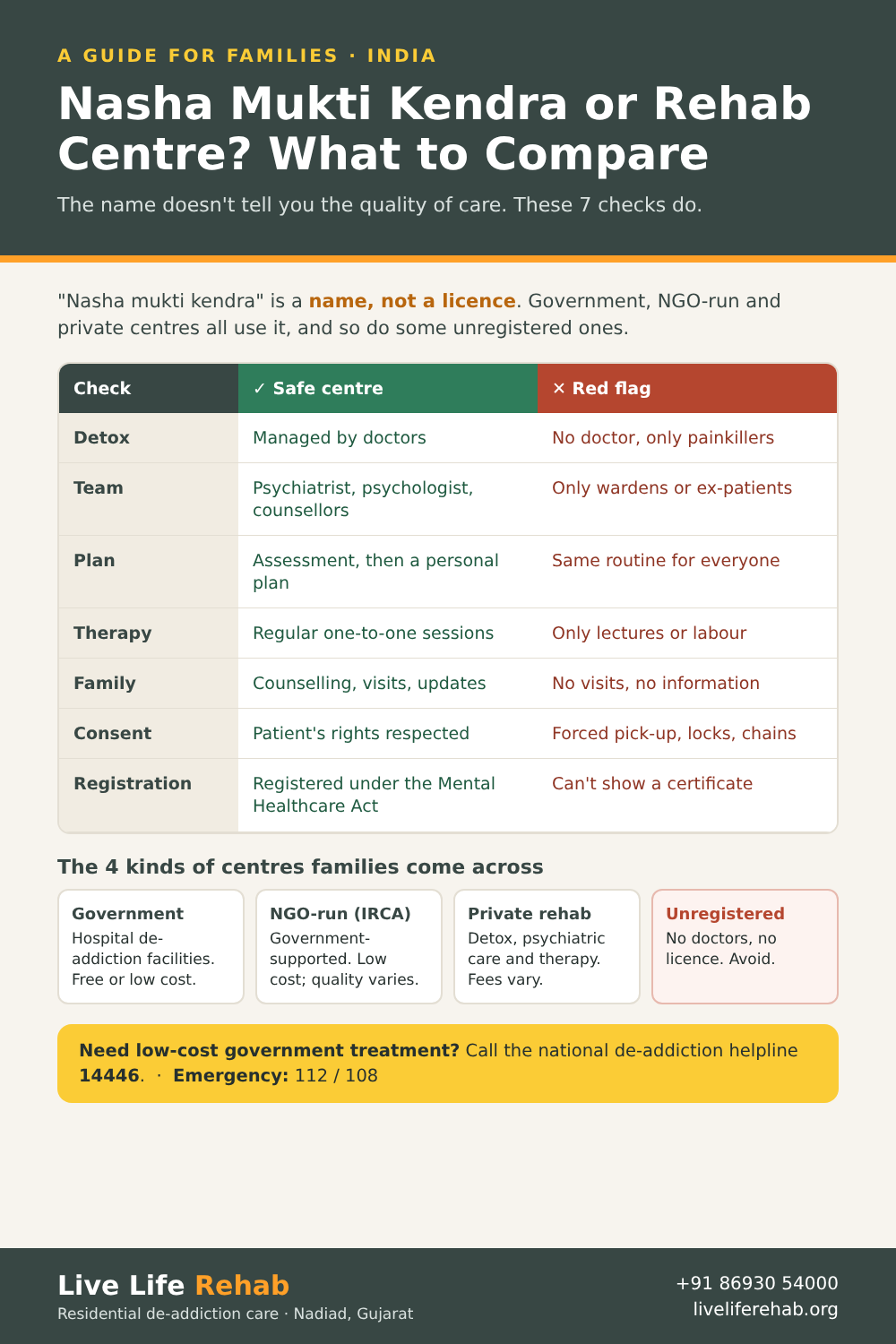
Nasha Mukti Kendra vs Private Rehab Centre: What Should You Compare?
Instead of comparing names, compare what actually happens inside. A good centre of any kind, government, NGO or private, should be able to answer “yes” to most of these:
| What to compare | What a safe centre offers | Red flag |
|---|---|---|
| Medical detox | Withdrawal managed by doctors, with medication where needed | “Detox” without any doctor, or only painkillers |
| Team | Psychiatrist or doctor, psychologist, trained counsellors, nursing staff | Only wardens or former patients running the centre |
| Treatment plan | Assessment first, then a written, personal plan | The same routine for everyone, whatever the problem |
| Therapy | Regular one-to-one sessions plus methods such as CBT or group therapy | Only lectures, prayers or physical labour |
| Family | Family counselling, visits and progress updates | No visits allowed, no information shared |
| Consent and dignity | Clear admission process that respects the patient’s rights | “Pick-up” of unwilling adults, locks, chains or punishment |
| After discharge | Relapse-prevention plan and follow-up | “Guaranteed cure” in a fixed number of days |
What Does the Law Say About De-addiction Centres?
India’s Mental Healthcare Act, 2017 includes “mental conditions associated with the abuse of alcohol and drugs” within its definition of mental illness. Under Section 65 of the Act, no person or organisation may establish or run a mental health establishment unless it is registered with the State Mental Health Authority. Centres that treat addiction come under this rule.
The Act also protects patients’ rights. Admitting an adult without their consent is only allowed under strict conditions, with qualified professionals involved. Our guide on how to help a family member with drug addiction explains this in more detail. This section is general information, not legal advice.
What Are the Warning Signs of an Unsafe Centre?
- It cannot show a registration certificate, or avoids the question
- There is no doctor or psychiatrist on the team, only “staff”
- It offers to “pick up” an adult against their will, or talks about locking patients in
- Families are not allowed to visit or speak to the patient for long periods
- Medicines are given without a doctor’s prescription
- It promises a “100% cure” or a fixed number of days to recovery
- The fee seems very low for everything that is promised, with no written breakdown
If you see these signs, look elsewhere. For help finding government-supported treatment, call the national drug de-addiction helpline on 14446.
What Should You Ask Before Admission?
- Is the centre registered with the State Mental Health Authority? Can we see the certificate?
- Who will treat my family member, and is there a psychiatrist?
- How is detox managed, and what happens in a medical emergency?
- How many one-to-one therapy sessions happen each week?
- How is the family involved, and when can we visit?
- What exactly does the fee include, and what is extra?
- What support is there after discharge?
For a fuller checklist, see our guide on how to choose the right drug rehab centre in Gujarat, and what happens in the first week at a rehab centre.
Which Option Is Right for Your Family?
- If money is very tight and safe detox is urgent, a government Addiction Treatment Facility or a well-run IRCA is a real and valuable option. Call 14446 to find the nearest one.
- If there are years of heavy use, earlier relapses, or a mental health condition such as depression or anxiety, a private residential centre with psychiatric care and regular one-to-one therapy usually gives a better chance of lasting recovery.
- If use is mild and the person is motivated, outpatient treatment with a psychiatrist may be enough to start with.
Whatever you choose, judge the centre on its medical care, therapy and honesty, not on its name or its furniture.
Live Life Rehab: Private Residential Care in Nadiad, Gujarat
Live Life Rehab is a private residential rehabilitation centre in Nadiad, serving families from Ahmedabad and across Gujarat. Many families find us by searching for a nasha mukti kendra near Ahmedabad. What they get is medically supervised detox, care from a team of doctors, psychologists and addiction counsellors, one-on-one therapy three times a week, and family counselling. We are happy to answer every question on the list above before admission.
Call +91 86930 54000 (India) or WhatsApp +91 79901 77863 (international families), or send us a message. Conversations are confidential.
Frequently Asked Questions
What is the difference between a nasha mukti kendra and a rehab centre?
The names often overlap. “Nasha mukti kendra” simply means a centre for freedom from addiction, and it is used by government, NGO-run and private centres alike. The real difference is in the care: whether there is medical detox, qualified doctors and therapists, proper registration and follow-up after discharge.
Are government nasha mukti kendras free?
Addiction Treatment Facilities in government hospitals and District De-Addiction Centres provide treatment free or at low cost, and NGO-run IRCAs supported by the government are low-cost or subsidised. The national helpline 14446 can point you to the nearest centre.
Does a de-addiction centre need to be registered?
Yes. Under Section 65 of the Mental Healthcare Act, 2017, no person or organisation may run a mental health establishment unless it is registered with the State Mental Health Authority, and centres treating addiction fall under the Act.
How can I check if a nasha mukti kendra is genuine?
Ask to see its registration certificate, meet the doctor or psychiatrist, visit the centre, ask how detox and emergencies are handled, and get a written breakdown of fees. Be cautious of centres that refuse visits, offer forced pick-ups or promise a guaranteed cure.
Can a nasha mukti kendra keep someone against their will?
Admitting an adult without consent is only allowed under strict conditions set out in the Mental Healthcare Act, 2017, with qualified professionals involved. Holding people by force, locking them in or punishing them is not treatment, and families should report it.
Is a private rehab centre better for alcohol addiction?
It depends on the person. Heavy, long-term drinking needs medically supervised detox, because alcohol withdrawal can be dangerous. Someone with relapses or a mental health condition usually benefits from the regular therapy and psychiatric care a good private residential centre provides. A government facility is a safe starting point when cost is the main barrier.