




 (+91 86930 54000)
What Is Ganja? Side Effects, Addiction Risk and Treatment in India
Ganja is the flowering top of the cannabis plant, and it is a drug in every sense that matters medically and legally. Its most common side effects are memory and concentration problems, anxiety and paranoia, chronic cough and bronchitis, and a slow loss of motivation that families usually notice before the person does. Around one in five to one in three regular users develops cannabis use disorder, and stopping after heavy daily use produces a real withdrawal syndrome with insomnia, irritability and appetite loss. Most of the cognitive effects improve with a few weeks of abstinence, though heavy and early use carries the longest-lasting risk.
Almost every family who calls us about ganja opens the same way. They say it’s only ganja, not a real drug, and then they describe a son who has stopped going to college, sleeps till two in the afternoon and gets aggressive when asked about it. Both halves of that sentence can’t be true at once, and the gap between them is where most of the delay in getting help happens.
This guide covers what ganja actually is and how it differs from charas and bhang, what it does to the body and brain in the short and long term, whether the damage reverses, how dependence develops, what withdrawal looks like day by day, what Indian law says, and how ganja addiction is treated.
What Is Ganja, and What Is It Called in English?
Ganja is cannabis. In English it’s usually called marijuana or weed, and the plant it comes from is Cannabis sativa.
Where most explanations go wrong, including several published by Indian rehabilitation centres, is treating ganja, charas and bhang as three words for the same thing. They aren’t. They come from different parts of the plant, they’re used differently, and Indian law treats them differently.
| What it is | How it’s used | Legal position in India | |
| Bhang | Leaves and seeds of the plant | Ground into a paste, drunk in thandai or eaten in sweets | Falls outside the NDPS Act’s definition of cannabis, so it’s permitted in some states and banned in others |
| Ganja | Flowering and fruiting tops | Smoked in a chillum, joint or increasingly a cigarette | Illegal under the NDPS Act |
| Charas | Resin collected from the plant | Smoked, usually mixed with tobacco | Illegal under the NDPS Act, with stricter quantity thresholds than ganja |
| Hashish | Another name for charas, the resin form | Same | Same as charas |
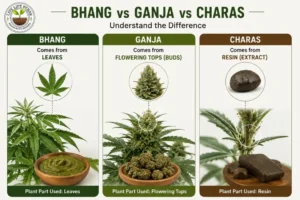
The reason the NDPS Act excludes bhang is a definitional one. The Act defines ganja as the flowering or fruiting tops of the cannabis plant, specifically excluding the seeds and leaves when they aren’t accompanied by the tops. Bhang is made from the leaves. So it slipped through the statutory definition, which is why you can find it sold under licence in parts of the country and banned outright in others, such as under the Assam Ganja and Bhang Prohibition Act of 1958.
Anyone reading this in Gujarat should not assume bhang is permitted here. State law on this varies and it’s worth checking rather than guessing.
The active compound in all forms is THC, which binds to receptors in the brain’s reward system. Charas has a higher concentration than ganja, which is why the legal threshold for charas is ten times lower.
Is Ganja a Drug?
Yes. It’s a psychoactive substance that changes how the brain works, produces tolerance, produces dependence in a substantial minority of users and has a recognised withdrawal syndrome in the DSM-5.
The confusion comes from ganja’s long history in India. It appears in Ayurvedic texts, sadhus use it in religious practice, and bhang is consumed openly at Holi in much of the country. All of that is real. None of it makes the pharmacology different. The plant that a sadhu smokes at a temple and the plant a nineteen-year-old smokes four times a day behind his hostel are the same plant acting on the same receptors, and the second pattern of use is the one that causes problems.
Cannabis is the second most commonly used substance among people who come for addiction treatment in India, after alcohol. That figure alone should settle the question of whether it’s a drug.
How Many People in India Use Cannabis?
The Ministry of Social Justice and Empowerment’s national survey, carried out by AIIMS and published in 2019, remains the only large-scale Indian data on this.
About 2.8% of Indians aged 10 to 75, roughly 3.1 crore people, had used some cannabis product in the previous twelve months. Splitting that: 2% or 2.2 crore for bhang, and 1.2% or 1.3 crore for ganja and charas. Around 72 lakh people, 0.66% of the population, needed help for a cannabis problem, and about 25 lakh were classed as dependent.
The survey also found that although bhang is more widely used, harmful and dependent use runs proportionately higher among ganja and charas users. Smoking a concentrated form several times a day does more damage than drinking a leaf preparation at a festival.
States above the national prevalence were Uttar Pradesh, Punjab, Sikkim, Chhattisgarh and Delhi. Gujarat isn’t on that list, which is worth saying plainly rather than inflating the local numbers. Our own admissions still see ganja regularly, usually in men in their twenties, and often alongside alcohol or tobacco. If you want to see how substance patterns differ across the country, we’ve mapped which Indian states carry the heaviest drug burden separately.
What Are the Short-Term Side Effects of Ganja?
The effects most people notice in the first few hours:
Slowed reaction time and poor coordination, which is why driving after smoking is genuinely dangerous. Short-term memory gaps, the sort where you lose the thread of a conversation halfway through. Raised heart rate, sometimes uncomfortably so. Red eyes, dry mouth, and a sharp increase in appetite.
The less-discussed short-term effect is anxiety. Ganja calms some people and makes others intensely anxious or paranoid, and which group you fall into isn’t predictable in advance. High-potency material makes the anxious reaction more likely. First-time users and people who accidentally take too much of an edible preparation are the most vulnerable, because eaten cannabis takes far longer to act and it’s easy to consume more while waiting to feel something.
What Are the Long-Term Side Effects of Ganja on the Body?
The lungs
This is where the popular claim, that ganja is exactly like cigarettes, turns out to be half right in an interesting way.
Smoking cannabis is strongly associated with chronic bronchitis symptoms, persistent cough, sputum, wheeze, chest tightness and visible inflammation of the airways on bronchoscopy. That much is well established. What the evidence does not show is a convincing link to COPD, which is the disease tobacco is famous for. Instead cannabis smokers show increased central airway resistance and lung hyperinflation.
Heavy cannabis smoking is also linked to bullous lung disease and spontaneous pneumothorax, a collapsed lung. Asthma tends to be worse controlled in regular users. And because cannabis smoke impairs the immune cells lining the lungs, users get more respiratory infections.
One practical note: in India, ganja and especially charas are very often smoked mixed with tobacco. So a lot of what presents clinically is a combined injury, and someone quitting ganja frequently has a nicotine dependence sitting underneath it that needs addressing at the same time.
The heart
THC raises heart rate and can raise blood pressure. In young healthy people this is usually tolerated. In anyone with existing cardiac disease it’s a real risk, and cases of heart attack shortly after cannabis use are documented.
The stomach
Long-term heavy use of high-THC cannabis can cause cannabis hyperemesis syndrome, repeated cycles of severe vomiting that improve only when cannabis is stopped. It gets misdiagnosed often, because the person is usually the last to suspect the drug they use to control nausea is causing it.
What Does Ganja Do to the Brain?
Regular use measurably affects attention, memory, learning and executive function, which is the capacity to plan, hold information and make decisions.
In practice this shows up as a person who has become unreliable. Deadlines slip. Instructions don’t stick. Marks drop. Families describe it as their son having become lazy, and the word they use for it is almost always a moral one rather than a clinical one, which is part of why help gets delayed.
The risk is meaningfully higher for people who start young. The brain is still developing through the teens and early twenties, and cannabis exposure during that window is associated with worse outcomes than the same exposure later. SAMHSA states that early-onset use can cost as much as eight IQ points permanently. That specific figure is contested, twin studies have found weaker or absent causal effects once shared family factors are controlled for, and we’d rather say so than quote a scary number as settled science. The general direction of the evidence is not in dispute even where the magnitude is.
Are the Side Effects of Ganja Permanent?
Mostly not, and this is the single most useful thing to tell someone who is trying to decide whether stopping is worth it.
The cognitive effects fade with abstinence. One meta-analysis found that the neurocognitive differences between cannabis users and non-users were no longer statistically significant after about 25 days without use. Another study found learning and memory impairments still present at seven days of abstinence but gone by 28 days.
So the fog lifts. It takes weeks rather than days, which matters, because a lot of people quit for four or five days, feel worse rather than better, and conclude that ganja was helping them. The first week is the worst week.
The honest qualifications: recovery looks less complete in people with a long history of very heavy use, where mild deficits in planning and decision-making can persist. And early-onset users show the most stubborn effects. The lungs improve after stopping too, and bronchitis symptoms settle, though bullous lung damage that has already occurred doesn’t reverse.
Can Ganja Cause Anxiety, Depression or Psychosis?
Ganja and anxiety have a circular relationship that traps a lot of people. Someone starts smoking to manage anxiety, it works for an hour or two, the anxiety rebounds harder as it wears off, and they smoke again. Within a few months the ganja has become the thing generating the anxiety it’s being used to treat. If you recognise that pattern, our guide to anxiety disorder in India covers the treatable condition underneath it.
Depression tracks with heavy use as well, though disentangling cause from effect is difficult, since low mood drives use and use worsens low mood.
Psychosis is the serious one. Cannabis can trigger psychotic episodes, paranoia, hearing things, fixed false beliefs, in people who are vulnerable to them, and heavy use of high-potency material raises that risk.
Less well known is that psychosis can also appear during withdrawal. A British Journal of Psychiatry review identified 68 cases of psychosis linked to cannabis withdrawal. The typical case was a man who used daily, stopped abruptly, and became psychotic within a week. The same review found that people who resumed cannabis after recovering relapsed far more often than those who stayed off it, by a wide margin.
This is the clinical reason we don’t advise anyone with heavy daily use to stop overnight at home without telling a doctor. Not because withdrawal is usually dangerous. Because occasionally it is, and there’s no way to know in advance which case you’re looking at.
Is Ganja Addictive?
Yes, though not in the way heroin or alcohol are, and the difference is why the myth survives.
Cannabis dependence is mainly psychological rather than physical. There’s no medical emergency of the kind you see with alcohol withdrawal seizures. What there is: tolerance, so the same amount stops working. Craving. Loss of control over how much and how often. And continued use despite it visibly damaging work, studies and relationships.
Estimates suggest 20% to 30% of regular users meet the criteria for cannabis use disorder. The risk climbs with daily use, with starting young, and with high-potency products.
A meta-analysis published in JAMA Network Open found that nearly half of people who use cannabis regularly experience withdrawal symptoms when they try to stop. Anyone who insists ganja isn’t addictive has usually never tried to stop after three years of daily use.
Signs that use has crossed into a disorder, in the language families actually use: he can’t get through a day without it, he gets angry when it isn’t available, he’s spending money he doesn’t have, he’s dropped the friends who don’t smoke, he’s tried to stop twice and couldn’t, and the things he used to care about have quietly disappeared from his life.
What Happens When Someone Stops Using Ganja?
Cannabis withdrawal is a recognised DSM-5 diagnosis with a fairly predictable course.
| Timeframe | What usually happens |
| First 24 hours | Irritability and restlessness begin. Sleep is disturbed the first night. |
| Days 2 to 6 | The peak. Insomnia, vivid or disturbing dreams, anger and aggression, anxiety, no appetite, low mood. Some people get headaches, sweating, nausea or stomach pain. |
| Week 2 | Symptoms fade for most people. Sleep is often the last thing to settle. |
| Weeks 3 to 6 | Cognitive fog clears. Cravings continue to surface, usually attached to particular places, people or times of day. |
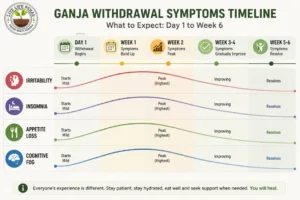
Sleep difficulty, restlessness, appetite loss and hostility are the four most commonly reported symptoms in clinical series.
The reason people relapse in this window isn’t weakness. It’s that days two to six are genuinely unpleasant and one smoke removes all of it instantly, which is a very hard bargain to refuse without support in the room. A structured setting exists mainly to get someone across those six days.
We won’t publish tapering schedules or medication doses for managing this at home. Withdrawal from heavy daily use should be assessed by a doctor, particularly if there’s any history of psychosis, any other substance involved, or any existing psychiatric diagnosis.
What Are the Benefits and Disadvantages of Ganja?
People ask this constantly and most treatment centres dodge it, which does nothing except make them look untrustworthy.
The honest position: there is real research into cannabis-derived medicines. Regulated, standardised formulations have shown benefit for particular conditions, chemotherapy-induced nausea and certain forms of epilepsy among them. That research exists and pretending otherwise isn’t useful to anyone.
What that research does not support is smoking street ganja. The gap between the two is the whole argument, and it comes down to four things. A medicine has a known compound at a known dose; street ganja has neither, and potency varies wildly between batches. Medical formulations are usually not smoked, which removes the entire respiratory problem. They’re prescribed for a diagnosed condition, monitored, and stopped when they stop helping. And they aren’t used four times a day for years to manage boredom.
The disadvantages sit on the other side of the ledger and this article has listed them. The one that families feel most is the flattening. The person is still physically present, still around the house, and has stopped wanting anything.
Why Is Ganja Illegal in India?
Ganja and charas are controlled under the Narcotic Drugs and Psychotropic Substances Act, 1985. Section 20 covers cannabis, and the penalty depends entirely on the quantity involved.
There are three statutory tiers, not four, and the thresholds are different for ganja and charas. A lot of what’s published online gets this wrong, including on the websites of Indian rehabilitation centres, which is a problem when the person reading it is a frightened parent trying to understand what their son is facing.
| Tier | Ganja | Charas | Penalty |
| Small quantity | Up to 1 kg | Up to 100 g | Rigorous imprisonment up to 1 year, or a fine up to ₹10,000, or both |
| More than small, less than commercial | 1 kg to 20 kg | 100 g to 1 kg | Rigorous imprisonment up to 10 years and a fine up to ₹1 lakh |
| Commercial quantity | 20 kg and above | 1 kg and above | Rigorous imprisonment of 10 to 20 years and a fine of ₹1 lakh to ₹2 lakh |
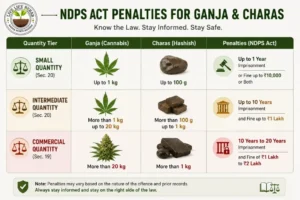
Offences involving commercial quantity are non-bailable under Section 37. Cultivating cannabis is punishable on its own regardless of quantity. Consumption is dealt with separately under Section 27.
This is general information and not legal advice. Anyone facing an NDPS case needs a criminal lawyer, not a website.
The consequences that aren’t in the statute matter too. A registered case affects government job applications, visa applications and police verification for years, long after any sentence is served.
How Do You Know If Someone at Home Is Using Ganja?
The physical signs are easy to miss and easy to explain away. Red eyes. A sweetish smell on clothes that doesn’t smell like cigarettes. Eye drops appearing. Incense or room spray being used at odd hours. Bloodshot eyes blamed on screens.
The behavioural pattern is more reliable. Sleep shifting later and later. Appetite spiking at strange times. Money going missing in small amounts. A new friend circle he won’t introduce. Losing interest in things he was serious about, cricket, gym, studies, without anything replacing them. Defensiveness that jumps to anger disproportionately fast when the subject comes up.
That last one is worth understanding rather than reacting to. Anger in that moment is usually fear of being found out, not contempt.
What tends to work when you raise it: pick a time when he’s not high, say what you’ve observed rather than what you’ve concluded, and don’t open with a demand or a threat. What tends to fail: searching his room and confronting him with the evidence, which turns the conversation into a case to be defended rather than a problem to be discussed. Families get one or two good conversations at this stage. Spending them on an argument is expensive.
 How Is Ganja Addiction Treated, and Is There a Medicine for It?
There is no approved medicine for cannabis use disorder. No regulator anywhere has approved a drug for it. Gabapentin, N-acetylcysteine, CBD and several others have been trialled with modest or inconsistent results, and any use of them is off-label and a doctor’s judgement call, not a standard protocol.
We’re saying this bluntly because “ganja addiction treatment medicine” is a common search, and someone who believes a pill exists will go and buy something at a chemist that either does nothing or causes a new problem.
What actually works is psychological, and the evidence for it is reasonably good. The combination with the best results is motivational enhancement therapy with cognitive behavioural therapy, run over more than a few sessions and longer than a month. Brief interventions don’t achieve much. Contingency management, which structures rewards around verified abstinence, adds to the effect. Family therapy matters particularly with younger users, since the home environment is usually part of both the problem and the solution.
Medication has a role where there’s something else to treat. Insomnia during the withdrawal week, an anxiety disorder underneath, a depressive illness, or a psychotic episode. Those are treated on their own terms, by a psychiatrist, alongside the addiction work rather than instead of it.
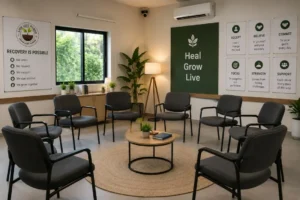
At Live Life Rehab, residential treatment for ganja and charas addiction runs as a 30-day programme at our Nadiad centre with medical supervision through the withdrawal period, individual and group therapy, and family sessions. Our medically supervised de-addiction programme covers the clinical side, and where a psychiatric condition sits alongside the substance use, our mental health treatment runs in parallel.
We’ll be honest about what treatment does and doesn’t do. Thirty days breaks the daily cycle and gives someone a clear head for the first time in months. It doesn’t guarantee he never smokes again. Relapse is common with cannabis, more common than families expect, and what separates the people who recover is usually not the strength of their first attempt but whether they came back after the first slip instead of disappearing. Be wary of any centre that promises you a cure rate. Nobody who has actually done this work would.
FREQUENTLY ASKED QUESTIONS
Q1. Is ganja the same as charas and bhang?
No. Ganja is the flowering top of the cannabis plant, charas is the resin, and bhang is made from the leaves. They differ in strength and in law. Charas is more concentrated than ganja, and bhang falls outside the NDPS Act’s definition of cannabis, which is why its legal status varies by state.
Q2. How long do ganja side effects last?
Intoxication lasts a few hours when smoked and considerably longer when eaten. The mental fog after regular use takes longer to clear, with most studies showing memory and attention returning to normal somewhere between three and four weeks of abstinence.
Q3. Does ganja affect the liver?
Ganja is not established as a direct cause of liver damage the way alcohol is, and the research on cannabis and liver disease remains mixed. In practice the people asking this are often drinking as well, and alcohol is the far bigger threat to the liver. If that applies, read our guide on the long-term effects of alcohol on the body.
Q4. Does ganja cause hair loss?
There’s no solid evidence that ganja directly causes hair loss. The plausible routes are indirect. Heavy use raises cortisol in some people, and stress is a known trigger for telogen effluvium, the diffuse shedding that follows a physical or emotional shock. Poor eating and disrupted sleep contribute too. Shedding of that type usually reverses once the trigger is removed.
Q5. Can ganja addiction be cured?
It can be treated, and many people stop for good. Cure is the wrong word for any addiction, because the vulnerability doesn’t disappear. What changes is that the person builds the capacity to notice a craving and not act on it.
Q6. Why does someone become so angry and unable to sleep after quitting ganja?
That’s cannabis withdrawal, and it’s a recognised clinical syndrome rather than a character flaw. Irritability, aggression and insomnia are among its most common symptoms. They start within about a day, peak between days two and six, and mostly settle within two weeks.
Q7. Is there a medicine for ganja addiction?
No approved one. Several medicines have been studied with inconsistent results, and any use is off-label. Treatment for cannabis use disorder is primarily psychological, with medication used for accompanying conditions like insomnia, anxiety or psychosis.
Q8. Is bhang legal in India?
It’s complicated and depends on the state. Bhang is made from cannabis leaves, which fall outside the NDPS Act’s definition of cannabis, so the central prohibition doesn’t reach it. Individual states have their own laws, and some ban it outright. Don’t assume it’s permitted where you live.