





 (+91 86930 54000)
Cough Syrup Addiction in India
Cough syrup addiction is dependency on codeine-based cough medicine, and it behaves like heroin dependency because codeine converts to morphine once it reaches the liver. Indian clinical research found that 54% of people treated for it had reached daily use within a single month of starting. It is one of the most common addictions in India and one of the least recognised, mostly because the bottle looks like medicine rather than a drug.
There is a version of this conversation we have regularly. A mother rings and says her son has been unwell for months, always tired, always short with her, and she has found bottles in his room. She wants to know whether cough syrup can really do that. She has usually been told by someone that it’s harmless because a chemist sold it.
The honest answer is that it can do considerably more than that, and the reason families arrive late to it is built into the packaging.
This guide covers whether cough syrup is addictive, what daily use actually does, how fast dependency develops, why it’s so common in India, where it sits legally, the signs families tend to miss, what long-term use does to the body, the withdrawal timeline day by day, what treatment involves, and when cough syrup use becomes a medical emergency.
Is Cough Syrup Addictive?
Yes, if it contains codeine.
Codeine is an opioid. Once swallowed, the liver converts part of it into morphine, which acts on the same receptors in the brain that heroin acts on. The effect is milder. The mechanism is identical, and so is the dependency that follows.
This is the part people resist. Cough syrup sits on a chemist’s shelf with a dosage cap and gets prescribed by doctors for real reasons. None of that changes what codeine does once it reaches the brain. Someone drinking large amounts of codeine syrup every day is dependent on an opioid, whether or not anybody in the family would use that word.
Not every cough syrup contains codeine. Many are antihistamine or dextromethorphan based and carry different risks. The syrups that get misused in India are overwhelmingly the codeine ones.
Is It Safe to Take Cough Syrup Every Day?
No, and this deserves a proper answer because it’s the question people ask before they’ll accept anything else.
A codeine syrup is designed for short-term use, typically a few days for a dry cough that hasn’t responded to anything else. Taken that way under a prescription, it does its job and stops.
Daily use is a different thing. Tolerance builds fast with opioids, so the amount that worked in week one stops working by week three. The dose goes up. At some point the syrup stops being about the cough and becomes about how the person feels without it. Most people cross that line without noticing.
If you’re reading this because you’ve been taking cough syrup every night for a few weeks and something about it has started to feel wrong, that instinct is worth acting on. Stopping now is far easier than stopping in six months.
How Quickly Does Cough Syrup Dependency Develop?
Faster than almost anyone expects.
The most-cited Indian clinical study on this is by Mattoo and colleagues, published in the journal Addiction, covering 46 people who came for treatment specifically for codeine cough syrup dependence. The findings on speed are the ones worth knowing.
| What the study found | Figure |
| Reached daily use within six months | 89% |
| Reached daily use within one month | 54% |
| Reported opioid-type withdrawal | 92% |
| Introduced to it by friends | 89% |
| Started out of curiosity | 63% |
| Felt more alert on it, rather than drowsy | 96% |
| Felt more active on it | 94% |
| Average age at first use | 23 years |
| Average age at treatment | 27 years |
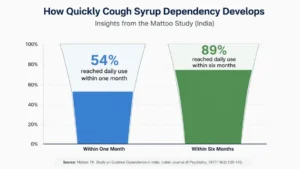
Two of those rows explain why families miss this for years.
The first is speed. Fifty-four percent got to daily use inside a month. There is no long window in which a family might notice a gradual change, because for half of these patients there wasn’t a gradual change.
The second is the alertness finding. Families watch for drowsiness. They’re looking for someone slumped and sedated. What they get is someone who seems energetic and talkative, which is nobody’s mental image of a person with a drug problem. The researchers attributed this to an opioid being combined with a stimulant-type ingredient in the same bottle, producing an effect quite unlike what you’d expect from cough medicine.
The study dates from 1997, so read the numbers as a picture of how this addiction behaves rather than a current headcount. Nearly thirty years on, the pattern in our admissions has not changed much.
Why Cough Syrup Addiction Is Common in India
Three things make this a particularly Indian problem.
It’s cheap. A bottle costs a fraction of any street drug, which puts it within reach of school and college students and of people who would never consider buying heroin.
It’s easy to get. Codeine syrup is prescription-only on paper. In practice plenty of chemists sell it without asking, and someone wanting several bottles a week can spread purchases across different shops so no single chemist sees the pattern.
And it doesn’t feel like a drug. Nobody hides a cough syrup bottle the way they’d hide a needle. It sits in the bathroom cabinet, and a family member who finds one thinks nothing of it.
The scale of pharmaceutical opioid use here is documented. The national survey conducted by AIIMS through its National Drug Dependence Treatment Centre found pharmaceutical opioids to be the second most commonly used opioid in India at 0.96% current use, behind heroin at 1.14%. Overall opioid use was 2.06%, with roughly 0.55% of Indians estimated to need help for an opioid problem.
Enforcement activity through 2026 gives some sense of the volumes moving. In February the Uttarakhand drug administration suspended codeine cough syrup production at a manufacturing unit near Dehradun, and police in Bihar and Chhattisgarh seized 1,800 bottles in separate operations. By March, unchecked online sale of these medicines was being raised in the Rajya Sabha. In August the Narcotics Control Bureau traced a supply chain to a warehouse in Vadodara and recovered 13,938 bottles of codeine cough syrup alongside 12,240 Tramadol tablets, with batch numbers on many bottles altered to hide the source of the stock.
That last one happened in Gujarat, around two hours from where we treat people for exactly this.
Is Cough Syrup Legal in India?
This gets stated wrongly often enough that it’s worth setting out accurately.
Codeine-based cough syrups at ordinary therapeutic strength are not covered by the NDPS Act. They sit under Schedule H of the Drugs and Cosmetics Rules, with the more restrictive Schedule H1 category applying to several of them. The exemption comes from a notification issued in November 1985, and a syrup containing around 9.5mg of codeine phosphate per 5ml falls inside it.
Practically, that means stocking and selling these syrups does not attract NDPS provisions, but they remain prescription-only medicines that can legally be dispensed only against a prescription from a registered medical practitioner. Buying them without one is not legal, even though it happens constantly.
The picture changes when the quantities stop looking medical. Courts have been handling cases of large-scale stocking and sale that has nothing to do with treating anyone’s cough, and the Allahabad High Court recently examined whether that kind of dealing can be shielded from the NDPS Act simply because the substance falls under the Drugs and Cosmetics Act. Uttar Pradesh has been pursuing diversion cases under NDPS.
So: legal with a prescription, illegal without one, and prosecuted as a narcotics offence when the scale makes therapeutic use implausible.
For a family reading this, the legal position matters less than it sounds. Someone drinking four bottles a day has a medical problem regardless of which schedule the bottle falls under.
What Are the Signs of Cough Syrup Addiction?
The behavioural signs usually appear before the physical ones.
| Category | What to look for |
| Physical | Persistent constipation, small pupils, disrupted sleep, poor appetite, weight loss, a sweet smell on the breath |
| Behavioural | Defensiveness about the syrup out of proportion to the question, irritability that lifts after leaving the house, secrecy about where they’ve been |
| Practical | Empty bottles in bins, bags or cupboards when nobody has been ill, buying from several different chemists, money going missing |
| Functional | Falling attendance or performance at work or college, withdrawing from people they used to see |
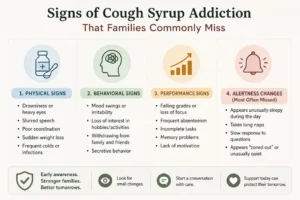
Constipation is worth singling out because it’s the most reliable physical sign and the one families dismiss. Opioids slow the gut, and it doesn’t improve with diet while the person is still using.
The thing not to look for is sedation. As the Mattoo study found, most people on codeine syrup feel more alert rather than sleepy, which is why the person often seems fine right up to the point they clearly aren’t.
Street names vary by region and families sometimes hear a word without knowing what it means. If your relative uses a term for something they drink that you don’t recognise, ask about it directly.
What Does Long-Term Cough Syrup Use Do to the Body?
Sustained heavy use causes damage on several fronts.
The liver takes the heaviest load, partly from the codeine and partly from other ingredients in the formulation, some of which are toxic in large daily doses over long periods. Chronic constipation can become severe enough to need medical intervention. Because opioids suppress breathing, high doses carry a real overdose risk, and that risk rises sharply if the person is also drinking alcohol or taking sedatives.
Sleep breaks down, so people often report sleeping long stretches without feeling rested. Concentration and memory get worse. Mood problems are common and tend to deepen the longer use continues, which then becomes another reason to keep using.
Tolerance sits underneath all of it. The dose has to keep climbing to produce the same effect, so someone who started on 10ml can end up drinking several full bottles a day. Every physical consequence worsens in step with the dose.
What Happens When Someone Stops? The Withdrawal Timeline
Codeine withdrawal is opioid withdrawal and should be treated as such. In the Mattoo study, 92% of patients reported opioid-type withdrawal symptoms. That’s the main reason people who genuinely want to stop find they can’t.
| Time since last dose | What usually happens |
| 8 to 24 hours | Onset. Restlessness, anxiety, yawning, runny nose, watering eyes, sweating, muscle aches, cravings begin |
| 24 to 48 hours | Symptoms intensify. Body aches worsen, insomnia sets in, pupils dilate, goosebumps, appetite disappears |
| 48 to 72 hours | Usual peak. Nausea, vomiting, stomach cramps, diarrhoea, severe restlessness, strongest cravings |
| Day 4 to day 7 | Physical symptoms begin easing. Sleep stays broken. Appetite returns unevenly |
| Week 2 onwards | Physical symptoms largely resolved. Low mood, poor sleep and cravings can persist for weeks |
Codeine withdrawal is not generally life-threatening in the way alcohol withdrawal can be. What it reliably is, is bad enough that most people take a bottle to make it stop. That’s where supervision changes the outcome, because medication manages the symptoms and somebody else is there to get the person through the worst of it.
The last row causes more relapse than the middle ones. Someone gets through the hard week, feels proud, and then finds that three weeks later they still can’t sleep and still want a bottle at nine in the evening. Nobody warned them, so they conclude they can’t do it. That phase needs support rather than willpower.
Anyone stopping after heavy daily use should do it with medical cover rather than alone at home.
How Is Cough Syrup Addiction Treated?
Treatment has two halves, and doing only the first is why people relapse.
The first is getting the person off the syrup safely. That means a medical assessment covering how much they’ve been using and for how long, their physical condition, and any other substances or medication involved. A doctor sets the withdrawal plan from that. Symptoms are managed with medication and monitored around the clock. This part usually runs several days to a week.
We won’t publish which medications or at what doses, because it depends entirely on the person’s severity, liver function, age and what else they’re taking. Self-medicating through opioid withdrawal with whatever is available at home is how people end up in emergency rooms.
The second half is the work on why it started. Almost nobody becomes dependent on cough syrup for no reason. Behind it there’s usually stress, untreated anxiety or depression, a difficult home situation, or something the person has never talked about. If that goes unaddressed the syrup comes back, or something else takes its place.
Our residential de-addiction programme runs 30 to 90 days depending on how long the dependency has lasted and what home looks like. Days follow a fixed structure of individual counselling, group sessions, meals at set times and physical activity. Families attend counselling sessions during the stay, because recovery tends to be tested at home rather than at the centre. Where there’s an anxiety or depressive condition underneath the use, our mental health treatment runs alongside the addiction work.
A relapse prevention plan is in place before anyone is discharged, and we stay in contact afterwards.
Be sceptical of anyone offering a one-week detox as a cure. It’s a necessary first step being sold as a finish line.
Cough Syrup Overdose: When to Get Help Immediately
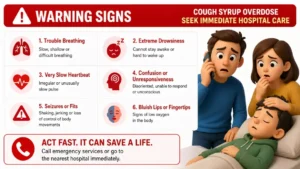
Opioids suppress breathing. That is what makes a large dose dangerous, and the danger is much higher if alcohol or sleeping tablets have been taken alongside it.
Go to a hospital straight away, without waiting to see if it settles, if any of these appear:
Breathing that is slow, shallow or noisy. Lips or fingertips turning blue or grey. The person cannot be woken properly, or wakes and drifts off again. Pinpoint pupils. Skin that is cold and clammy. Vomiting while barely conscious. A limp body with no resistance when moved.
Take the bottle with you, or a photo of the label. The first thing a doctor will ask is what was taken and how much, and families in a panic frequently can’t answer it.
If the person is unconscious and vomiting, turn them onto their side while you wait for help so they don’t choke.
Getting Help at Live Life Rehab
We treat cough syrup and other prescription medication dependency at our residential centre in Nadiad, Gujarat.
Harish Keni, who founded Live Life Rehab in 2017, meets every person admitted for a one-to-one session and sits separately with their family. That happens for every admission.
If you’ve been taking cough syrup daily and want to stop, or you’re worried about someone at home, the first call costs nothing and commits you to nothing. We’ll tell you honestly whether residential treatment is what’s needed.
+91 86930 54000

FREQUENTLY ASKED QUESTIONS
Q1. Is cough syrup addictive?
Codeine-based cough syrups are addictive because codeine is an opioid that converts to morphine in the body. It acts on the same brain receptors as heroin, more mildly, and produces the same kind of dependency with regular use. Syrups without codeine carry different risks.
Q2. Is it bad to take cough syrup every day?
Yes. Codeine syrups are meant for short courses of a few days. Daily use builds tolerance quickly, so the dose climbs and dependency can develop within weeks. In Indian clinical research on people treated for cough syrup dependence, 54% had reached daily use within a month of starting.
Q3. Does cough syrup show up on a drug test?
Codeine is an opioid and will show as an opiate on a standard drug screen. A valid prescription explains its presence but does not prevent detection. Detection windows vary by test type and by how much has been taken.
Q4. What should someone do if they have taken too much cough syrup?
Get medical help immediately. Opioids suppress breathing, so a large dose is dangerous, and the risk is much higher if alcohol or sedatives have also been taken. Slow or shallow breathing, blue lips, pinpoint pupils or difficulty waking the person are emergencies.
Q5. What are the withdrawal symptoms of cough syrup addiction?
Body aches, muscle and joint pain, restlessness, sweating, runny nose, watering eyes, nausea, stomach cramps, diarrhoea and insomnia, with strong cravings throughout. Symptoms usually begin 8 to 24 hours after the last dose and peak between 48 and 72 hours. Low mood and poor sleep can last several weeks longer.
Q6. Is cough syrup addiction as serious as alcohol addiction?
It carries a different set of risks rather than a lesser one. Alcohol withdrawal can be fatal, which codeine withdrawal generally isn’t. But cough syrup dependency is opioid dependency, it develops faster than most alcohol dependency does, and the overdose risk is real because opioids suppress breathing.
Q7. Can someone stop cough syrup on their own?
Some manage it, particularly where use has been light or brief. After heavy daily use it’s difficult, because withdrawal is severe enough that most people take a bottle to end it. Medical supervision manages the symptoms and makes stopping realistic.
Q8. Why does my son seem energetic rather than sleepy?
This is the most common reason families don’t recognise cough syrup use. In the Mattoo study, 96% of patients reported feeling more alert on codeine syrup and 94% felt more active. The formulation combines an opioid with a stimulant-type ingredient, so the person appears animated rather than sedated.
Q9. How long does treatment take?
Withdrawal itself takes several days to a week. Residential programmes usually run 30 to 90 days depending on how long the dependency has lasted, whether other substances are involved, and what support exists at home.