
 (+91 86930 54000)
Which Indian States Have the Worst Drug Problem? A 2026 Guide to Addiction and Substances
Drug addiction in India isn’t spread evenly. Some states carry a far heavier burden than others, shaped by geography, border routes, and which substances happen to flow through them. If you’re trying to understand the scale of the problem, or worried about someone in your own family, it helps to see where things actually stand rather than the vague “drugs are everywhere” picture.
This guide pulls together official data, mainly from the Narcotics Control Bureau (NCB) 2025 report and the Government of India’s 2019 national survey on substance use (still the most recent comprehensive survey of its kind), to show which states are worst affected, which drugs are most common, and how the picture looks here in Gujarat. A note before we start: India doesn’t publish a clean city-by-city ranking of addiction rates. What official sources do track is seizures, enforcement cases, and survey-based prevalence by state, so that’s what we’ve used, and we’ve said clearly where a figure is a seizure statistic rather than an addiction rate.
How Big Is India’s Drug Problem?
The scale is large and growing. Roughly 60 million people in India use drugs, about 2% of the population, and the country has seen a sharp rise in narcotic consumption over the past decade. The Supreme Court has called rising drug abuse among youth a generational threat, and the government has launched a Vision Document on Drug Control for 2026 to 2029 to coordinate the response.
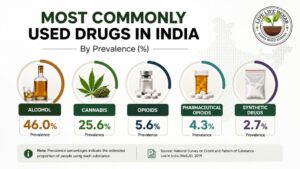
Alcohol is still the most widely used addictive substance, affecting roughly 14 to 16% of the population, with a smaller share dependent on it. After alcohol, the biggest concerns are opioids (including heroin and the local “brown sugar“), cannabis (ganja and charas), and a fast-growing problem with pharmaceutical drugs like codeine cough syrup, tramadol, and alprazolam.
States With the Highest Drug Burden
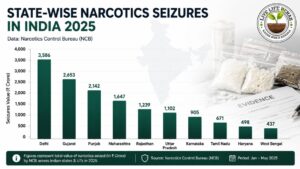
Based on NCB 2025 seizure data and government survey figures, these states stand out. Remember these are largely seizure and enforcement figures, which reflect trafficking volume and enforcement activity, not a pure headcount of addicts.
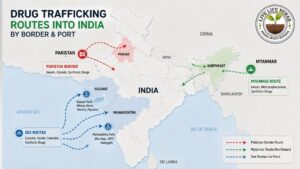
Punjab — the most talked-about state in India’s drug crisis. Punjab accounted for 58% of the country’s total heroin seizures in 2025 and nearly all of the drone-based smuggling cases along the India-Pakistan border. Its position on the “Golden Crescent” trafficking route drives a serious heroin and, increasingly, synthetic drug problem, with a large share of its youth affected. Punjab also saw huge seizures of codeine-based cough syrup.
Gujarat — high on the list, largely because of its long coastline. Gujarat’s ports handle a significant share of drugs entering India by sea, and enforcement has ramped up sharply, seizures rose several-fold since 2020. In one major 2024 operation, a very large heroin shipment was intercepted near Mundra port. High seizure numbers here reflect Gujarat’s role as a trafficking entry point more than local consumption, but the presence of drugs inevitably feeds local addiction too.
Maharashtra — Mumbai’s dual role as a major port and a large urban market makes Maharashtra significant, with notable seizures of cannabis and synthetic drugs like MDMA and mephedrone. Several clandestine synthetic-drug labs have been dismantled in the state.
Delhi — a major consumption market, with rising cocaine use among urban residents and consistently high overall seizure values.
The Northeast (Mizoram, Manipur) — highly vulnerable because of the porous border with Myanmar, which supplies a large share of the heroin consumed in India. Mizoram alone accounted for a big share of the country’s synthetic drug (ATS) seizures in 2025.
Rajasthan, Madhya Pradesh — flagged for synthetic drug manufacturing, with illegal units producing mephedrone and related substances.
The Most Commonly Used Drugs in India
Alcohol — by far the most widely used, and the one families most often overlook until dependency is severe. High-functioning alcohol addiction among working professionals is a growing, quietly serious problem.
Opioids — heroin and “brown sugar” — heroin, often sold in its adulterated street form “brown sugar” or “smack,” is one of the most damaging and addictive substances in India. Cannabis remained the most frequently seized drug overall in 2025, but opioids cause a large share of the treatment demand.
Cannabis — ganja and charas — widely used across the country and often wrongly seen as harmless, cannabis dependency is real and common, especially among young users.
Pharmaceutical / prescription drugs — a fast-rising category. Codeine cough syrup, tramadol, buprenorphine, and alprazolam are increasingly misused, partly because they’re easier to obtain than street drugs. The NCB flagged a significant rise in pharmaceutical drug diversion between 2021 and 2025.
Synthetic drugs — meth, MD (mephedrone), MDMA — a growing urban problem, with domestic manufacturing increasing. In Gujarat and Maharashtra, “MD” (mephedrone) has become a particularly common street drug.
The Picture in Gujarat
Gujarat sits in an unusual position. As a coastal state with busy ports, it’s a major entry point for drugs by sea, which is why its seizure figures are among the highest in the country. But high seizures don’t automatically mean high local addiction, they reflect trafficking as much as consumption.
That said, the drugs that pass through do fuel a real local problem. In our work at Live Life Rehab, the cases we see most often across Gujarat involve alcohol, brown sugar (heroin), ganja and charas, and increasingly MD (mephedrone) and prescription-drug dependency among younger users. Alcohol remains the single biggest reason families reach out, often after years of quietly hoping it would resolve on its own.
The encouraging part is that Gujarat also has a growing network of de-addiction support, from government Nasha Mukti and IRCA centres to private rehabilitation centres, so families here do have options across a range of budgets.
Why Some Regions Are Hit Harder Than Others
A few clear factors explain the uneven map:
Borders. Punjab (Pakistan) and the Northeast (Myanmar) are entry points for heroin and synthetic drugs, so they carry a heavier burden.
Ports. Coastal states like Gujarat and Maharashtra see large sea-route trafficking.
Urban demand. Big cities like Delhi and Mumbai are consumption markets, driving cocaine and synthetic drug use.
Local manufacturing. Rajasthan, Maharashtra, and Madhya Pradesh have seen synthetic-drug labs dismantled.
Youth vulnerability. Across all regions, early initiation (often between 14 and 17), academic pressure, unemployment, and easy access are pushing more young people into use earlier.
What Families Can Do
Data on states and substances matters, but for most families reading this, the real question is simpler: what do we do about someone we love?
A few honest points. Addiction is treatable, and it’s not a moral failing. The earlier it’s addressed, the easier recovery is, so waiting rarely helps. For moderate to severe dependency, especially with alcohol or opioids, medically supervised treatment is safer and far more effective than trying to stop at home, since withdrawal from some substances can be dangerous. And treatment works best when it addresses what’s underneath the addiction, not just the substance.
If you’re in Gujarat and want to understand the options, from government Nasha Mukti centres to private de-addiction programs, you can reach our team at Live Life Rehab for a confidential, no-pressure conversation.
Sources
- National Survey on Extent and Pattern of Substance Use in India (2019), Ministry of Social Justice & Empowerment, Government of India — https://socialjustice.gov.in/writereaddata/UploadFile/Survey%20Report.pdf
- Narcotics Control Bureau (NCB), Government of India — https://narcoticsindia.nic.in/
- National Narcotics Coordination Portal (NCORD) national reports — https://narcoordindia.gov.in/narcoordindia/national-reports.php
- United Nations Office on Drugs and Crime (UNODC), South Asia — https://www.unodc.org/southasia/
Frequently Asked Questions
Which state has the worst drug problem in India?
Punjab is the most affected by trafficking, accounting for around 58% of India’s total heroin seizures in 2025 and nearly all drone-based smuggling cases along the India-Pakistan border. However, “worst” depends on how you measure it — Punjab leads on heroin, the Northeast (Mizoram, Manipur) is heavily affected by Myanmar-route drugs, and states like Gujarat and Maharashtra see high seizures due to ports. These are enforcement figures, not pure addiction rates.
What is the most commonly used drug in India?
Alcohol is by far the most widely used addictive substance, with around 14.6% of the population using it according to the 2019 national survey. After alcohol, cannabis (ganja and charas) and opioids (including heroin/brown sugar) are the most common, with a fast-growing problem in misused pharmaceutical drugs like codeine cough syrup, tramadol, and alprazolam.
Why does Gujarat have high drug seizure numbers?
Gujarat’s long coastline and busy ports make it a major entry point for drugs smuggled by sea, so its seizure figures are among the highest in India. High seizures reflect Gujarat’s role as a trafficking route more than local consumption — though the drugs passing through do fuel local addiction, especially alcohol, brown sugar, ganja, and increasingly MD (mephedrone).
Is drug addiction increasing in India?
Yes. India has seen a sharp rise in narcotic consumption over the past decade, with roughly 60 million drug users. The Supreme Court has called rising youth drug abuse a generational threat, and early initiation (often between ages 14 and 17) is a growing concern.
What are the most common drugs among Indian youth?
Cannabis, alcohol, and increasingly synthetic drugs and misused pharmaceuticals are common among young users. Easy access, academic pressure, peer influence, and digital exposure are driving earlier experimentation, often in the 14-17 age range.
Where can families get help for drug addiction in Gujarat?
Options range from government Nasha Mukti and IRCA centres (low or no cost) to private de-addiction and rehabilitation centres across a range of budgets. For a confidential, no-pressure conversation about the options, families can contact Live Life Rehab, which runs centres in Ahmedabad and Nadiad.