




 (+91 86930 54000)
Alcohol Withdrawal Symptoms and Timeline: What Happens Day by Day
Alcohol withdrawal symptoms usually begin within 6 to 12 hours of the last drink and peak between 24 and 72 hours. Most people experience tremors, sweating, anxiety, nausea and insomnia, and recover within a week. Around 3 to 5% develop something more serious, with seizures most likely in the first 48 hours and delirium tremens appearing between 48 and 72 hours. Alcohol is one of the few substances whose withdrawal can be fatal, which is why anyone drinking heavily every day should not stop abruptly without medical supervision.
There is a conversation we have with families almost every week. Somebody has decided that from tomorrow, he stops. No more drinking. They have thrown the bottles away and they are asking us what to expect.
The question behind that question is usually whether it is safe, and they are often surprised that the answer isn’t automatically yes. Cannabis withdrawal is miserable and not dangerous. Nicotine withdrawal is irritating and not dangerous. Alcohol sits in a different category, and the difference matters more in the first three days than at any other point.
This guide covers when symptoms start, what happens on each day, which day tends to be worst, why nights are harder than mornings, what seizures and delirium tremens actually are, who is most at risk, why withdrawal often gets worse each time somebody tries, and what medical treatment involves.
What Is Alcohol Withdrawal?
Alcohol slows the brain down. It boosts the chemical that calms neural activity, GABA, and suppresses the one that excites it, glutamate.
When someone drinks heavily for years, the brain stops accepting this as a temporary state and rebuilds itself around it. It reduces its own calming machinery and increases its excitatory signalling to hold a normal balance while alcohol is present. At that point the person needs alcohol simply to feel ordinary, which is what tolerance actually is.
Take the alcohol away suddenly and the compensation is exposed. There is now far too much excitatory signalling and not enough to hold it down. The brain goes into a state of hyperexcitability, and every symptom of withdrawal comes from that. The shaking, the racing heart, the sweating, the anxiety that arrives without a reason, and in the worst cases the seizures.
This is worth understanding rather than skipping, because it explains something families struggle with. What looks like weakness on day three is a nervous system in a measurably abnormal state. Nobody talks themselves out of it.
Can Alcohol Withdrawal Kill You?
Yes, though not usually, and the honest version of this answer has two halves.
Most people who stop drinking have an unpleasant week and come through it. Around 3 to 5% of people going through alcohol withdrawal develop the severe form, meaning seizures or delirium tremens. Among long-term heavy drinkers, the lifetime risk of developing delirium tremens is roughly 5%.
The other half of the answer is that when it does go wrong, it goes wrong badly. Untreated delirium tremens carries a mortality rate reported between 20% and 37% depending on the study. Treated early, that falls to somewhere in the range of 5 to 15%. Death usually comes from the body losing the ability to regulate its own temperature, from dangerous heart rhythms, or from seizures that don’t stop.
So the risk is not that withdrawal is generally lethal. The risk is that a small proportion of cases become a medical emergency, and there is no reliable way for a family at home to know in advance which case they are looking at. That asymmetry is the whole argument for supervision. Most people don’t need it. The ones who do, need it urgently, and by the time it’s obvious the window has narrowed.
For comparison, we’ve written separately about ganja withdrawal, which is genuinely difficult and carries no comparable physical danger. Alcohol and benzodiazepines are the two withdrawals that require medical caution.
When Do Withdrawal Symptoms Start?
Sooner than most people expect. Mild symptoms can appear within 6 hours of the last drink, and are usually present by 12 hours.
Someone who drinks every evening and stops after dinner will often wake in the early hours already sweating, restless and unable to get back to sleep. They frequently don’t connect that to withdrawal. They assume they’ve eaten something wrong or that they’re coming down with a fever.
The earliest signs are insomnia, tremor in the hands, mild anxiety, loss of appetite, headache, sweating, stomach upset and a heart that feels like it’s working too hard. All of it comes from the same nervous system overactivity.
What Happens Day by Day?
| Time since last drink | What usually happens |
| 6 to 12 hours | Hand tremor, sweating, anxiety, nausea, headache, no appetite, disturbed sleep. Raised heart rate and blood pressure. |
| 12 to 24 hours | Symptoms intensify. Some people begin to see or hear things that aren’t there while still knowing they aren’t real. Vomiting and diarrhoea are common. |
| 24 to 48 hours | The highest-risk window for withdrawal seizures. Symptoms are usually at or near their peak. |
| 48 to 72 hours | Peak for most people. If delirium tremens is going to develop, it usually appears here, though it can begin as late as day five. |
| Day 4 to day 7 | Symptoms start settling for most people. Sleep stays broken. Appetite returns unevenly. |
| Week 2 | Physical symptoms have largely resolved. Research suggests the brain begins returning to normal function around this point. |
| Weeks 3 to 8 | Anxiety, low mood, poor sleep and cravings can persist. This phase gets underestimated and it’s when a lot of people go back to drinking. |
One thing families ask constantly, because it appears in the small print of every recovery story: what happens on day 4? For most people day four is when it starts easing. The tremor is reducing, the sweating has stopped, and there is a first stretch of proper sleep. For a minority, day four is when delirium tremens declares itself. Both are true, which is why day four is not a point at which supervision can be dropped.
Which Day Is the Worst, and Why Do Symptoms Feel Worse at Night?
Days two and three are the worst for the majority of people. That’s the peak of the physical symptoms and it’s the window in which the dangerous complications appear.
The night question comes up so often that it deserves a straight answer, and there are several reasons for it.
Alcohol suppresses REM sleep. When it’s removed, REM rebounds hard, which produces vivid and often disturbing dreams and a night of fragmented, unsatisfying sleep. Second, there is nothing to do at 3am. During the day, work, conversation and movement compete for attention with the tremor and the anxiety. At night the symptoms have the field to themselves. Third, and clinically most relevant, delirium and confusion characteristically worsen in the evening and overnight. Nocturnal agitation in withdrawal is recognised well enough that hospitals plan for it specifically.
The practical consequence: if someone is being watched at home during withdrawal, the night is when they need watching most and it’s exactly when everybody is asleep.
What Are the Three Stages of Alcohol Withdrawal?
Clinicians commonly describe three stages, and knowing them helps a family judge what they’re seeing.
| Stage | What it looks like |
| Mild | Headache, insomnia, anxiety, hand tremor, stomach upset, heart palpitations |
| Moderate | All of the above plus rising blood pressure and heart rate, confusion, mild fever, rapid shallow breathing |
| Severe | All of the above plus hallucinations, seizures, disorientation and an inability to hold attention |
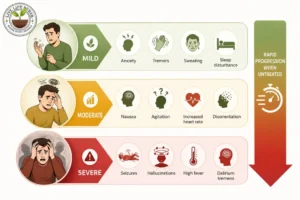
The part worth knowing is that people can move from moderate to severe quickly when nobody is managing it. It isn’t a staircase somebody climbs slowly with time to reconsider at each step.
In hospital settings this is scored using a scale called the CIWA-Ar, which rates ten symptoms and produces a number that guides how aggressively to treat. An Indian study of patients admitted for alcohol withdrawal found a mean score of 11.54, which sits in the moderate range and indicates a group needing careful monitoring rather than reassurance.
What Are Alcohol Withdrawal Seizures?
A withdrawal seizure is a generalised convulsion caused by the brain’s hyperexcitable state. It typically happens within the first 48 hours, and roughly 10% of people going through untreated withdrawal will have one.
Two things about them are useful to know.
They are not epilepsy, though they look identical to a bystander. Epilepsy is an ongoing condition with its own causes. A withdrawal seizure is a one-off event driven by a specific chemical situation, and it doesn’t mean the person now has epilepsy. Someone who does have epilepsy and drinks heavily is at considerably higher risk during withdrawal, as is anyone with a past head injury.
And a withdrawal seizure is a warning about what comes next. Someone who has a seizure is significantly more likely to go on to develop delirium tremens. Research also indicates that people with a history of withdrawal seizures carry a substantially raised risk of death, which reflects both the severity of their dependence and the cumulative damage behind it.
If a seizure happens, that is a hospital, not a wait-and-see. There is no version of managing that at home.
What Is Delirium Tremens?
Delirium tremens is the most severe form of alcohol withdrawal and it’s a medical emergency. It usually begins 48 to 72 hours after the last drink and can start as late as day five.
It is not simply worse shaking. The defining feature is delirium: the person loses their grip on where they are and what is happening. They see things that aren’t present, often insects or small animals, and unlike the hallucinations of earlier withdrawal they believe them. They may not recognise family. They become agitated, sometimes frightened, sometimes combative. Underneath that, the body becomes unstable, with fever, a racing heart, wildly fluctuating blood pressure and heavy sweating.
The autonomic instability is what kills people, not the confusion.
Indian hospital data gives a sense of how common a history of this is among people who reach treatment. In one study of patients admitted with alcohol withdrawal, 23% had experienced delirium tremens before and 24% had previously had withdrawal seizures. Among people already showing signs of severe dependence, a past episode is not unusual.
If someone in withdrawal becomes confused about where they are, stops recognising people, spikes a fever or becomes agitated in a way that seems disconnected from what’s around them, that is not a stage to sit through. It needs a hospital that night.
Who Is Most at Risk of Severe Withdrawal?
The risk factors that matter most, and the first two are the ones families most often don’t think to mention to a doctor:
A previous episode of delirium tremens or a previous withdrawal seizure. This is the single strongest predictor. If it happened once, the odds of it happening again are meaningfully higher.
Multiple previous attempts to stop. Explained in the next section, and it surprises people.
Duration and quantity. In the Indian study cited above, the average patient had been drinking for close to eighteen years, having started at around twenty-eight. Long histories carry heavier withdrawals.
Other physical illness. Liver disease, infection, poor nutrition, dehydration and electrolyte disturbance all worsen withdrawal and complicate treatment. Anyone who wants to understand what years of drinking does to the body more broadly can read our guide to the long-term effects of alcohol on the body.
Age. Older people withdraw harder and tolerate it less well.
Family history. In the same Indian study, 59% of patients had a family history of alcohol dependence.
Other substances. Someone using benzodiazepines alongside alcohol is in a genuinely dangerous position, because both withdrawals carry seizure risk and they compound.
Why Does Withdrawal Get Worse Every Time?
This is the section I would most want a family to read, because it inverts an assumption almost everybody holds.
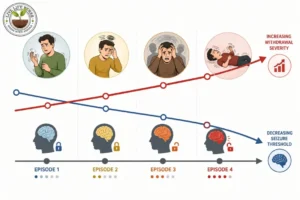
The intuition is that somebody who has stopped drinking three times before knows what to expect, so the fourth attempt should be easier. The opposite is true, and there is a name for the mechanism.
It’s called the kindling effect, borrowed from epilepsy research, where repeated small electrical stimuli that initially produce nothing eventually produce a seizure on their own. Each episode of alcohol withdrawal leaves the brain more reactive than it was. GABA’s ability to suppress excitatory firing drops and stays dropped for weeks afterwards. Sensitivity to glutamate rises long-term. These changes accumulate rather than resetting between attempts.
The practical result: somebody whose first withdrawal was mild tremor and a bad night’s sleep can, after several more cycles, have a seizure or develop delirium tremens on an identical amount of drinking. The seizure threshold has been lowered by the withdrawals themselves, not by the drinking.
Two things follow from this that matter.
The fifth attempt to stop at home is more dangerous than the first, not less, and the family’s experience of the previous four is a poor guide. And repeated cycles of stopping and restarting are worse for the brain than either drinking steadily or stopping properly once with support. It is a real argument against the pattern of quitting every Monday and drinking again by Thursday.
It’s also the reason clinicians treat even mild withdrawal properly rather than letting it ride. Managing this episode reduces how bad the next one will be.
Can Symptoms Last for Weeks or Months?
The physical symptoms are usually finished within a week to ten days. What continues is different in kind.
Anxiety, low mood, poor sleep, irritability and cravings can persist for weeks and sometimes months. Sleep is often the last thing to normalise and can take a couple of months to settle properly.
This phase gets very little attention and causes a great deal of relapse. Somebody gets through the hard week, feels proud, and then finds that four weeks later they still feel flat, still can’t sleep, and still want a drink at seven in the evening. Nobody warned them, so they conclude the alcohol was the only thing holding them together.
It isn’t a sign that treatment failed. It’s the brain slowly rebuilding a balance it dismantled over years. But it does need support through it, and where there’s an underlying anxiety or depressive condition sitting beneath the drinking, that needs treating on its own terms. Our mental health treatment runs alongside addiction work for exactly this reason.
Is It Safe to Stop Drinking at Home?
For someone who drinks moderately and occasionally, yes, and they probably won’t have significant withdrawal at all.
For someone drinking heavily every day, the answer is that it might be safe and there’s no way to know beforehand. Given that the failure mode is a medical emergency, that’s not a reasonable bet to take unadvised.
Anyone in these categories should not attempt it without a doctor: daily heavy drinking over years, any previous withdrawal seizure or episode of delirium tremens, several previous attempts to stop, existing liver disease or heart disease, benzodiazepine use alongside alcohol, older age, or living alone.
There’s one specific thing families do at home while trying to help that I want to flag, because it isn’t obvious and it can cause harm.
Heavy drinkers are almost always deficient in thiamine, vitamin B1. Alcohol reduces how much they eat, how much they absorb, and how much the liver can store. Thiamine is what allows brain cells to use glucose for energy. If you give a thiamine-deficient person a large glucose load, sugary drinks, glucose powder, sweetened juice, IV dextrose, the remaining thiamine gets consumed rapidly and this can precipitate Wernicke’s encephalopathy, a serious brain injury that causes confusion, unsteadiness and eye movement problems, and which can progress to permanent memory loss.
Clinical protocols therefore give thiamine before glucose, every time. Families trying to build somebody up with sweet drinks during withdrawal are doing the opposite of what’s needed and don’t know it. This is one of several reasons that fluids, glucose and vitamins during withdrawal belong in a medical setting rather than a kitchen.
While we’re on supplements: routine magnesium has not been shown to improve withdrawal symptoms and is only useful if levels are actually low, which requires a blood test to establish. It isn’t a home remedy for the shakes.
How Is Alcohol Withdrawal Treated Medically?
Treatment does three things: keeps the person comfortable, prevents progression to seizures and delirium, and reduces the severity of future withdrawals.
The medications used are benzodiazepines, which act on the same GABA system as alcohol and can therefore substitute for it in a controlled, reducing way. They are prescription-only, and we won’t publish which ones or at what doses, because the answer depends entirely on the individual’s severity, liver function, age and what else they’re taking. This is the one part of withdrawal management that genuinely cannot be templated, and self-dosing benzodiazepines while alcohol is still in the system is how people stop breathing.
Alongside that: thiamine and other vitamins, correction of fluids and electrolytes, treatment of whatever else is going on physically, and monitoring of blood pressure, heart rhythm and temperature. Dosing is guided by scoring the symptoms rather than by a fixed schedule, which is why somebody has to be watching.
Our medically supervised alcohol detox at the Nadiad centre runs on that basis, with the withdrawal period managed by a psychiatrist and a doctor available through it.

Why Is Detox on Its Own Not Enough?
Because detox treats withdrawal, and withdrawal isn’t the illness.
There is Indian research that makes this uncomfortably clear. A study followed patients who had presented with delirium tremens, comparing those who received emergency treatment only against those who went on to comprehensive inpatient addiction treatment. Among the emergency-care-only group who could be followed up, 70% had relapsed at six months and 15% were still abstinent.
Those were people who had been through the most severe form of alcohol withdrawal, survived it, been stabilised, and sent home. Seven in ten were drinking again within half a year.
Detox is the first week. It buys a clear head and a body that isn’t in crisis. What decides whether somebody is still sober in a year is what happens after: the reason they were drinking, the situations that trigger it, what the family does differently, and whether there’s an untreated psychiatric condition underneath. Our residential de-addiction programme is built around that period rather than the withdrawal week, and our nasha mukti kendra in Gujarat runs family sessions as part of it, because in our experience the home the person returns to determines the outcome more than the treatment does.
Be sceptical of anyone offering detox as a cure. It’s a necessary first step being sold as a finish line.
Alcohol Withdrawal Emergency: When to Go to Hospital Straight Away
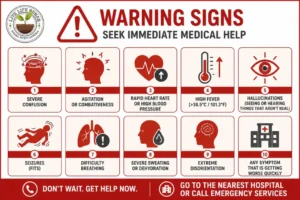
Don’t wait, don’t discuss it, go, if any of these appear:
A seizure of any kind. Confusion about where they are or who people are. A fever. Hallucinations they believe are real. Agitation that seems disconnected from their surroundings. Vomiting that won’t stop, or any blood in it. Chest pain or a heart rate that stays very high. Or if they simply cannot be roused properly.
Take a note of what and how much they normally drink and when the last drink was. It’s the first thing a doctor will ask and families in a panic frequently can’t answer it.
FREQUENTLY ASKED QUESTIONS
Q1. What happens on day 4 of not drinking?
For most people day four is when things start improving, with the tremor and sweating easing and the first proper sleep. For a small number, day four is when delirium tremens appears, since it can begin as late as the fifth day. Both are possible, which is why supervision shouldn’t stop at day three.
Q2. Can alcohol withdrawal cause fever?
Yes. A mild raised temperature is common in moderate withdrawal. A significant fever is a warning sign, either of severe withdrawal moving toward delirium tremens or of an infection that has been missed, and it needs medical assessment rather than paracetamol at home.
Q3. Can alcohol withdrawal cause itching?
It can. Itching during withdrawal usually comes from the nervous system overactivity or from the heavy sweating. Persistent itching in someone who has drunk heavily for years can also point to liver disease, which is worth investigating separately.
Q4. Can alcohol withdrawal cause high blood pressure?
Yes, and it’s one of the more reliable indicators of how severe the withdrawal is. Blood pressure and heart rate both rise as part of the same overactivity, and both are monitored during supervised detox for that reason.
Q5. Can someone have hallucinations without having delirium tremens?
Yes, and the difference matters. In alcoholic hallucinosis, which can appear in the first 24 hours, the person sees or hears things but knows they aren’t real and is otherwise oriented. In delirium tremens they believe the hallucinations and have lost their grip on where they are. The second is an emergency.
Q6. Are alcohol withdrawal seizures the same as epilepsy?
No. A withdrawal seizure is a single event caused by a temporary chemical state and doesn’t mean the person has epilepsy. Someone who does have epilepsy faces a considerably higher risk during withdrawal and should never stop drinking without medical supervision.
Q7. Does everyone who stops drinking get withdrawal symptoms?
No. Withdrawal happens in people who have become physically dependent, which generally means heavy and regular drinking sustained over a long period. Somebody who drinks occasionally can stop without any of this.
Q8. Why was withdrawal worse this time than last time?
This is the kindling effect. Each withdrawal episode leaves the brain more reactive and lowers the seizure threshold, so later attempts can be more severe than earlier ones even when the drinking hasn’t changed. It’s a reason to stop with medical support rather than attempting it repeatedly alone.