
The most effective way to help someone with drug addiction is to stay connected, stop the reactions that push them away, and keep a specific treatment option ready for the moment they are willing to listen. Shouting, threats and emotional blackmail rarely work. Calm, consistent family involvement does: in a well-known study of families using a structured approach called CRAFT, 64% got their loved one into treatment, compared with 30% for confrontational “interventions”.
Most families who contact a rehab centre start with the same questions. Is this really addiction? Is it our fault? How do we get him to agree to treatment? Can we admit her without her consent? This guide answers each of them, in the order families usually face them.
It covers why families in India often find out late, what to check first, what not to do, what research says actually works, how to talk about rehab, what to do if your loved one refuses, what Indian law says about admission without consent, when a situation is an emergency, and how to prepare for the first call to a treatment centre.
Why Do Families in India Often Find Out So Late?
Addiction in India usually stays hidden for months or years before a family acts. The reasons are rarely a lack of love. They are mostly about stigma, fear and how normal some substances look.
- Family reputation. Worry about what relatives, neighbours or a future marriage alliance will think keeps many families silent.
- Substances that look harmless. Cough syrup is bought from a chemist, ganja is often treated as a “habit”, and alcohol is socially accepted. Families do not see them as drugs until dependence is advanced.
- Money that keeps flowing. In joint families, the person using often has access to cash from several relatives, which hides the financial warning signs.
- Hoping it will pass. Many families wait for a job, a marriage or a move to “fix” the problem.
The result is a very large treatment gap. India’s national survey, Magnitude of Substance Use in India (AIIMS NDDTC for the Ministry of Social Justice and Empowerment, 2019), found that only about 1 in 38 people with alcohol dependence had received any treatment, and only 1 in 20 people dependent on illicit drugs had ever received inpatient treatment. Families who act earlier change those odds.
First, Is It Really Addiction?
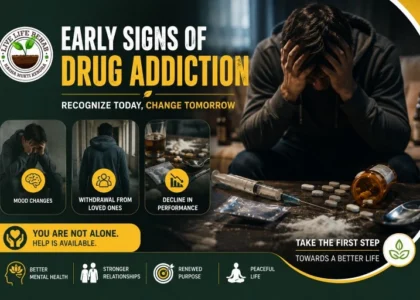
Before planning what to say, be reasonably sure what you are dealing with. Occasional use and dependence need different responses. Common signs of dependence include:
- Using more, or more often, than before, and failing when they try to cut down
- Withdrawal symptoms such as restlessness, sweating, body pain, poor sleep or irritability when they cannot use
- Money or valuables going missing, unexplained debts or repeated requests for cash
- Falling performance at work or college, and dropping old friends and interests
- Secrecy, lying about where they were, and sharp mood swings
For a fuller checklist, read our guides to the early signs of drug addiction and the top 10 signs a loved one may need rehab. If the substance is something specific, our pages on ganja and charas addiction, heroin and brown sugar addiction and meth addiction explain what to expect.
What Should You Not Do?
Most of the mistakes families make come from fear and love, not from carelessness. Knowing them in advance makes them easier to avoid.
- Do not shout, insult or shame them in front of others. Shame is one of the strongest drivers of continued use. It pushes the person further into secrecy.
- Do not lock them in a room or physically restrain them. Apart from being dangerous, sudden withdrawal from alcohol or sleeping pills can cause seizures and needs medical care.
- Do not hand over cash or pay off drug debts “one last time”. Pay for real needs such as rent, fees or medicine directly instead.
- Do not cover up for them with an employer, college or relatives. Shielding them from consequences removes a reason to change.
- Do not treat marriage as the cure. Getting someone married in the hope they will settle down usually adds a second family to the crisis rather than solving it.
- Do not rely only on home remedies or spiritual healing. Faith and community can be a real support in recovery, but addiction is a medical condition and needs medical assessment alongside them.
What Actually Helps? The CRAFT Approach Explained
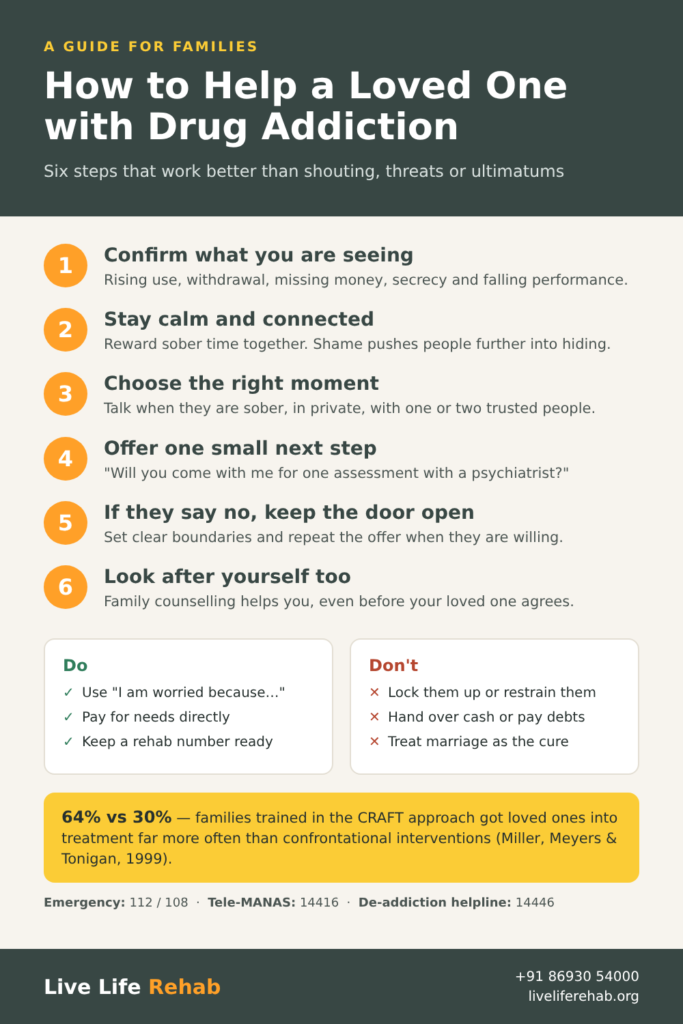
CRAFT stands for Community Reinforcement and Family Training. It is an evidence-based method that teaches family members how to influence a loved one’s behaviour without confrontation. In the study by Miller, Meyers and Tonigan (1999), families trained in CRAFT got 64% of unmotivated loved ones into treatment, compared with 30% for the confrontational Johnson-style intervention and 13% for families referred to Al-Anon support.
The core ideas are simple enough to start using at home:
- Reward sober moments. Spend time, cook their favourite food or go out together when they are not using. Pull back warmly, without a lecture, when they are.
- Let natural consequences happen. If they miss work after a night of using, do not phone in sick for them.
- Change how you communicate. Speak calmly, describe specific behaviour and say how it affects you, rather than labelling them.
- Watch for the window. Regret after a bad night, a health scare or trouble at work often opens a short period when someone is willing to talk about help. Have a plan ready for that moment.
- Look after yourself. A calmer, healthier family member is more effective, and CRAFT families report better wellbeing even when the loved one does not yet enter treatment.
How Do You Talk to a Loved One About Rehab?
One calm conversation at the right time does more than many angry ones. Prepare it the way you would prepare for any important family discussion.
Choose the right time and place
Talk when they are sober, rested and not in the middle of a fight, ideally in private. Morning is often better than night. Keep it to one or two people they trust and respect; a room full of relatives feels like an ambush.
Use “I” statements, not accusations
| Instead of saying | Try saying |
|---|---|
| “You are ruining this family.” | “I am frightened when you come home like that, because I love you.” |
| “You are a drug addict.” | “I have noticed you need it every day now, and you seem unwell when you don’t have it.” |
| “If you don’t stop, you are out of this house.” | “I want to help you get proper treatment, and I will support you through it.” |
| “Why can’t you just stop?” | “It looks really hard to stop on your own. Would you talk to a doctor with me?” |
Offer a specific, small next step
“Go to rehab” can sound enormous. “Will you come with me for one assessment with a psychiatrist on Saturday?” is easier to agree to. Have the phone number, the address and a possible appointment time ready before you start the conversation.
Expect a “no” the first time
Denial and anger are common first reactions. Stay calm, do not argue, and leave the door open: “All right. The offer stands whenever you are ready.” Many people agree days or weeks later, often after a difficult episode.
What If They Refuse Treatment?
Refusal is not the end of the road. It means the family’s work continues in a different form.
- Ask for something smaller. A check-up with a doctor about sleep, weight loss or stomach problems can lead naturally to an addiction assessment.
- Set clear, calm boundaries about money, using at home or driving under the influence, and keep them consistently.
- Get counselling for yourselves. Family members can see a counsellor even if the person using will not. This is the core of CRAFT.
- Keep returning to the offer in each new window of willingness, without “I told you so”.
Can You Admit Someone to Rehab Without Their Consent in India?
This is one of the most common questions families ask, and the honest answer is: usually not, and only under strict legal conditions.
India’s Mental Healthcare Act, 2017 includes substance use disorders within its definition of mental illness. It sets out two main routes for adults:
- Independent admission, where the person agrees to treatment and admits themselves. This is the standard and preferred route.
- Supported admission (Sections 89 and 90), which is possible only when strict criteria are met. These include recent self-harm or attempts, violence or threats towards others, or an inability to care for oneself that puts the person at real risk. It requires an application by a nominated representative, independent examination by qualified professionals including a psychiatrist, and reporting to the Mental Health Review Board.
Be cautious of any centre that offers to “pick up” an unwilling adult and hold them without these safeguards. Before admitting anyone, ask the centre whether a psychiatrist will assess the patient, how consent is handled, and what the discharge process is. This section is general information, not legal advice; a psychiatrist can explain how the law applies to your situation.
When Is It an Emergency?
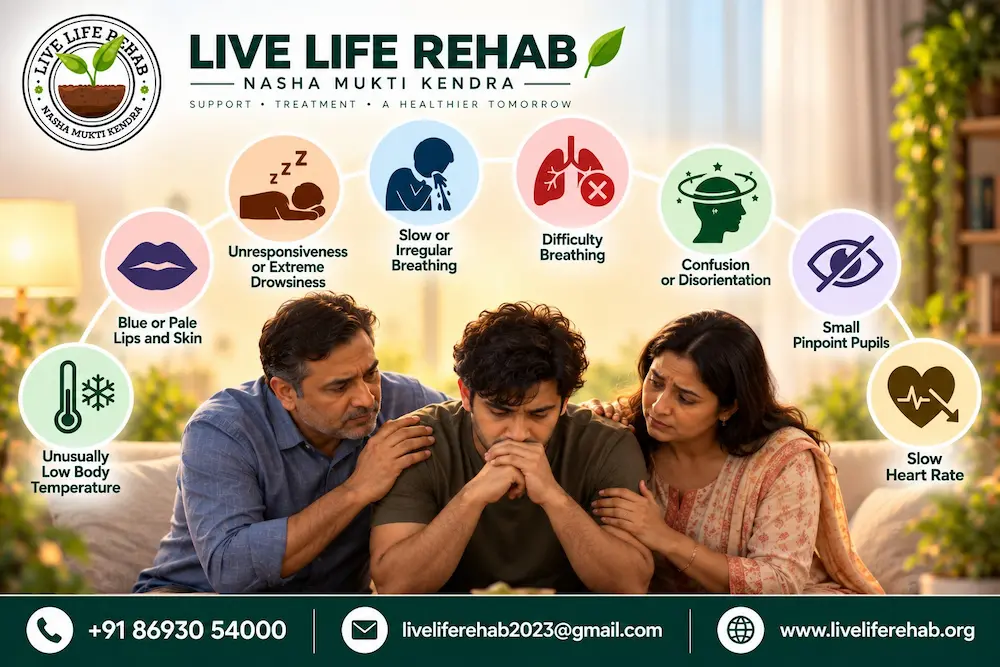
Some situations cannot wait for the right conversation. Call 112 or 108 for an ambulance, or go to the nearest hospital emergency department, if your loved one:
- Is unconscious, cannot be woken, or is breathing very slowly or noisily
- Has blue or grey lips or fingertips, or pinpoint pupils after using opioids such as heroin, brown sugar or codeine syrup
- Has a seizure, severe confusion or hallucinations, especially while stopping alcohol or sleeping pills
- Has chest pain, a very high temperature or extreme agitation after using stimulants
- Talks about suicide or has harmed themselves
For emotional support at any hour, India’s national mental health helpline Tele-MANAS is available on 14416, and the Ministry of Social Justice and Empowerment’s toll-free drug de-addiction helpline is 14446.
How Should You Prepare for the First Call to a Rehab Centre?
A prepared first call saves time and helps the team advise you properly. Note down:
- Which substances are being used, how much, how often and for how long
- When they last used, and any withdrawal symptoms you have seen
- Physical or mental health conditions and current medicines
- Any previous treatment or attempts to quit, and what happened
- Whether they currently agree to treatment
And ask the centre:
- Is there a psychiatrist on the team, and is detox medically supervised?
- What therapies are used, and is there family counselling?
- How long is a typical programme, and what happens after discharge?
- What are the fees, and what is included?
Our guides on what happens in the first week at a rehab centre and the cost of a rehabilitation centre in Gujarat answer many of these in detail.
How Can You Look After Yourself While Helping?
Living with someone’s addiction is exhausting. Parents and spouses commonly experience anxiety, poor sleep, guilt and anger. None of this means you have failed.
- It is not your fault. Addiction develops from a mix of biology, environment and stress. You did not cause it, and you cannot control it alone.
- Share the load. Choose one or two trusted relatives or friends to talk to honestly.
- Protect your health and finances. Keep valuables secure and keep your own routines, sleep and medical care.
- Get support for yourself through family counselling, a family support group or Tele-MANAS on 14416.
Getting Help at Live Life Rehab

Live Life Rehab is a residential rehabilitation centre near Ahmedabad, in Nadiad, Gujarat. Families can call us before their loved one has agreed to anything: we will listen, explain the options and help you plan the conversation.
Treatment includes medically supervised de-addiction treatment, psychiatric care, individual and group therapy, and family counselling. You can read more about our treatment methods, our medical team and our nasha mukti programme.
Call +91 86930 54000 (India) or WhatsApp +91 79901 77863 (international families), or send us a message. Conversations are confidential.
Frequently Asked Questions
Should I give money to a family member with drug addiction?
It is safer not to give cash. Pay directly for genuine needs such as rent, fees, food or medicines, so your support does not fund continued drug use.
Does rehab work if the person did not want to go at first?
Many people who enter treatment reluctantly, after pressure from family or work, still benefit. Motivation often grows once withdrawal is managed and therapy begins. What matters most is that treatment is safe, ethical and led by qualified professionals.
How long does drug rehabilitation take?
It depends on the substance, how long it has been used and the person’s health. Detox usually takes days to a couple of weeks, and residential programmes often continue for several weeks to a few months, followed by aftercare. The treating team will recommend a duration after assessment.
Is my family member’s addiction my fault?
No. Addiction is a health condition shaped by many factors, including genetics, mental health, stress and the people around them. Families did not cause it, but they can play a powerful role in recovery.
Can family members attend counselling at a rehab centre?
Yes. Family counselling helps relatives understand addiction, rebuild trust and prepare for life after discharge. At Live Life Rehab, family sessions are part of the treatment plan.
Is there a free helpline for drug addiction in India?
Yes. The Ministry of Social Justice and Empowerment runs a toll-free drug de-addiction helpline on 14446, and Tele-MANAS on 14416 offers free mental health support around the clock.