




 (+91 86930 54000)
Anxiety Disorder: Symptoms, Causes and Treatment in India
Anxiety is the body’s alarm system, and it becomes a disorder when that alarm keeps ringing after the danger is gone or rings when there’s no danger at all. Common signs include a racing heart, chest tightness, constant worry, and trouble sleeping. Anxiety disorders are the most common mental health condition in India, and they respond well to treatment through therapy, medication where needed, and lifestyle changes.
Most people who come to us worried about anxiety don’t start by saying “I think I have an anxiety disorder.” They say their heart races for no reason. They can’t sleep. They snapped at their kids again. One man told me he’d been to three cardiologists in a year, convinced something was wrong with his heart, and every test came back clean. What he actually had was panic disorder, and he’d spent a year and a lot of money looking in the wrong place.
That gap, between what anxiety feels like and what people think is happening to them, is where a lot of suffering hides. This guide covers what anxiety actually is, how to recognise it, what’s driving it in India right now, and what genuinely helps.
What Is Anxiety, and When Does Normal Worry Become a Disorder?
Anxiety is your body’s alarm system. A bit of it is healthy. It’s what makes you prepare for an exam, drive carefully, or feel nervous before a big meeting. That kind of worry passes once the situation does.
It becomes a disorder when the alarm keeps ringing after the danger is gone, or rings when there’s no danger at all. The worry stops being about one thing and starts attaching to everything. You lose sleep over problems that haven’t happened. You avoid situations because of how they might make you feel. It gets in the way of work, relationships, and daily life, and it doesn’t switch off when you tell it to.
A rough line: if the worry is out of proportion to the situation, lasts most days for six months or more, and you can’t control it no matter how hard you try, it’s worth treating as more than everyday stress. Anxiety disorders are the most common mental health condition in India, affecting tens of millions of people, and they respond well to treatment. Very few of those people ever get it.
Anxiety Symptoms: Physical, Mental and Behavioural Signs
Anxiety shows up in the body as much as the mind, which is exactly why so many people miss it. They go looking for a physical illness because the physical symptoms are so real.
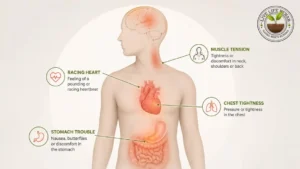 Physical Symptoms
These are the ones that send people to a GP or a cardiologist first:
- A racing or pounding heart
- Chest tightness or pain
- Shortness of breath, or feeling like you can’t get a full breath
- Sweating, trembling, or shaking
- Dizziness or feeling faint
- Stomach trouble, nausea, or a churning gut
- Muscle tension, especially in the neck, jaw, and shoulders
- Tingling or numbness in the hands or feet
- Trouble sleeping, or waking at 3am with your mind already racing
Mental and Emotional Symptoms
- Constant worry you can’t switch off
- A sense of dread, like something bad is about to happen
- Feeling on edge or restless
- Trouble concentrating, or your mind going blank
- Irritability
- Fear of losing control
Behavioural Signs
The quiet ones, often noticed by family before the person themselves: avoiding places or situations, cancelling plans, needing constant reassurance, checking things repeatedly, and leaning on alcohol or other substances to take the edge off.
Panic Attack vs Heart Attack: How to Tell the Difference
A panic attack can feel exactly like a heart attack. Chest pain, a hammering heart, sweating, the genuine belief that you’re about to die. This is one of the most frightening experiences a person can have, and one of the most misread. Here’s how they differ.
| Panic attack | Heart attack | |
| How the pain feels | Sharp or stabbing, stays in the chest | Heavy pressure or squeezing, often spreads to the arm, jaw, or back |
| What triggers it | Stress, a thought, or nothing obvious | Usually physical exertion |
| Timing | Peaks within about 10 minutes, then eases | Builds and persists or gets worse over time |
| Response to calming | Slow breathing often helps it settle | Does not improve with breathing or rest |
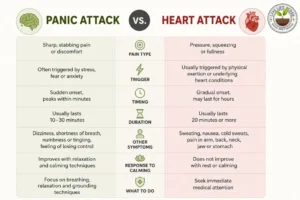
The honest catch: even doctors can’t always tell them apart without an ECG and blood tests. So the rule is simple. If chest pain is new, severe, spreading to your arm or jaw, or doesn’t ease within a few minutes of calming down, treat it as a medical emergency and get to a hospital. Don’t sit at home diagnosing yourself. Once a heart problem has been ruled out and the episodes keep coming back, that’s your sign to have anxiety properly assessed. Panic disorder is very treatable, and the relief people feel once they finally understand what’s happening to them is real.
What Causes Anxiety, and What’s Driving It in India Today
Anxiety usually comes from a mix of things rather than one cause: family history, brain chemistry, personality, and stressful or traumatic life events. Some medical conditions like thyroid problems can also mimic or trigger it, which is why a proper check-up matters.
Beyond the textbook causes, there are pressures specific to life in India right now that we see feeding anxiety in the people who walk through our doors:
- Academic pressure. The competition around exams, entrance tests, and marks puts enormous strain on students, sometimes from a very young age.
- Job and financial insecurity. Uncertain work, debt, and the pressure to provide sit heavily, especially on young earners and sole breadwinners.
- Family and social expectation. Marriage, career, and the constant worry about what people will think carry a weight that’s hard to explain to anyone outside it.
- Urban isolation. People move to cities like Ahmedabad for work and end up far from the family and community that used to absorb stress.
- Phones and social media. Constant comparison and constant availability keep the nervous system switched on with no off-button.
None of these are weaknesses. They’re real pressures, and it makes sense that they take a toll.
Types of Anxiety Disorders
Anxiety isn’t one condition. The common types:
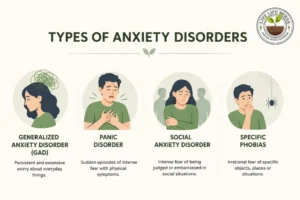
- Generalised anxiety disorder (GAD): persistent, excessive worry about many everyday things, most days, for months.
- Panic disorder: repeated panic attacks and the fear of having more.
- Social anxiety disorder: intense fear of being judged in social or performance situations.
- Specific phobias: overwhelming fear of a particular thing or situation, like heights or crowds.
- OCD and PTSD were once grouped with anxiety disorders and share a lot of overlap, though they’re now classified separately.
Knowing which type you’re dealing with matters, because the treatment is tailored to it.
Anxiety and Addiction: Why They Often Go Together
This is the pattern we see more than any other, and it’s the one most anxiety articles leave out. People with untreated anxiety often reach for something to quiet it. A few drinks to sleep. Something to calm the nerves before a social situation. It works, briefly, and that’s the trap.
Alcohol and drugs give short-term relief and then make anxiety worse, because the nervous system rebounds harder once the substance wears off. So you drink to calm down, feel more anxious the next day, and drink again. Over months this becomes two problems feeding each other: an anxiety disorder and a dependence.
When both are present, treating only one doesn’t work. If you dry someone out but leave the anxiety untouched, the anxiety drives them straight back to the substance. This is why proper assessment matters, and why at Live Life Rehab we look at the whole picture rather than one symptom. If anxiety is sitting underneath a drinking or drug problem, both have to be treated together.
How Is Anxiety Treated?
Anxiety is one of the more treatable mental health conditions. Most people improve a great deal with the right approach. Treatment usually combines a few things.
Therapy
Talking therapy is the foundation, and cognitive behavioural therapy (CBT) has the strongest track record for anxiety. It works by helping you notice the thought patterns that fuel the worry and change how you respond to them. For panic and phobias, a technique called exposure therapy, where you’re gradually and safely faced with what you fear until it loses its grip, is genuinely effective. It sounds daunting and it works.
Medication
For moderate to severe anxiety, medication can help, usually antidepressants (SSRIs) rather than the older sedatives. These take a few weeks to work and should always be managed by a psychiatrist. A word of caution we give everyone: benzodiazepines (the “calming” tablets like alprazolam) work fast, which is exactly why they’re risky. They’re meant for short-term use only. Taken regularly they cause dependence, and we’ve treated many people whose second addiction started with a prescription meant to help their anxiety.
Can You Treat Anxiety Without Medication?
For mild to moderate anxiety, often yes. Therapy alone helps many people, and lifestyle changes make a real difference. Medication isn’t always necessary, and whether you need it is a decision to make with a professional rather than on your own.
Lifestyle, Yoga and Breathing
Regular exercise, decent sleep, cutting back on caffeine, and breathing practices all genuinely reduce anxiety, and there’s good evidence behind yoga and meditation for this. Here’s the honest part, though: for a real anxiety disorder, these help alongside treatment, not instead of it. Anyone promising that yoga alone will cure severe anxiety is selling something. Use these to support your recovery, not to replace proper care.
How to Calm Anxiety Right Now: A Simple Grounding Technique
If anxiety or a panic attack is rising, this exercise gives your nervous system something to do other than panic. It’s called 5-4-3-2-1.
Look around and name: five things you can see, four things you can hear, three things you can touch, two things you can smell, and one thing you can taste. Go slowly. The point is to pull your attention out of the spiral of thoughts and back into the room.
Pair it with slow breathing: breathe in for four counts, hold for four, out for six. A longer out-breath tells your body the threat has passed. This won’t cure an anxiety disorder, but in the moment, it helps.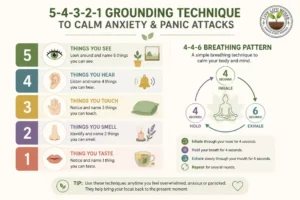
When and How to Get Help for Anxiety in India
The hardest part for most people isn’t the anxiety. It’s picking up the phone. Mental health still carries stigma here, and there’s a real shortage of psychologists and psychiatrists, so people wait years, or try to manage alone, or hope it passes. It rarely does on its own once it’s a disorder.
Getting help can start small. A conversation with a GP, a psychologist, or a counsellor is enough to begin. You don’t need to have hit rock bottom to deserve support. If anxiety is affecting your sleep, your work, your relationships, or if you’re using alcohol or anything else to cope, that’s reason enough to reach out.
At Live Life Rehab, we work with people dealing with anxiety, and with anxiety that’s become tangled up with addiction, at our centres in Nadiad and Ahmedabad. Our team is led by a psychologist, and the first conversation is confidential and free of judgement. Whether you come to us or go somewhere else, the important thing is that you talk to someone.
FREQUENTLY ASKED QUESTIONS
Q1. Is anxiety curable?
Anxiety is highly treatable, and many people recover fully or manage it so well it no longer runs their life. With therapy, and medication where needed, most people see a real improvement. Some manage occasional flare-ups long-term, the way you’d manage any health condition, but it stops being something that controls you.
Q2. What is the difference between stress and anxiety?
Stress is a response to a specific pressure, like a deadline or an exam, and it eases once the pressure is gone. Anxiety often lingers after the trigger has passed, or shows up with no clear trigger at all. When worry becomes constant, feels out of proportion, and doesn’t switch off, it’s moved beyond ordinary stress.
Q3. Can anxiety cause chest pain?
Yes. Chest pain, a racing heart, and shortness of breath are common physical symptoms of anxiety and panic attacks. That said, chest pain should never be assumed to be anxiety until a heart problem has been ruled out by a doctor, especially the first time it happens.
Q4. What is the best treatment for anxiety in India?
There’s no single best treatment for everyone. For most people it’s cognitive behavioural therapy (CBT), sometimes combined with medication managed by a psychiatrist, plus lifestyle changes. The right mix depends on the type and severity of your anxiety, which is why an assessment with a professional matters.
Q5. How much does anxiety treatment cost in India?
It varies widely depending on whether you need outpatient therapy sessions or residential care, and where you go. Individual therapy sessions are the most affordable starting point. For specifics on what treatment involves and costs at Live Life Rehab, you’re welcome to call for a straightforward answer.
Q6. When should I see a doctor for anxiety?
See someone if your anxiety lasts most days for several weeks, interferes with sleep, work, or relationships, causes panic attacks, or if you’re using alcohol or substances to cope. You don’t need to wait for a crisis.
Q7. Can anxiety go away on its own?
Mild, situational anxiety often passes once the stressful situation does. An anxiety disorder usually doesn’t. Without treatment it tends to persist or get worse, which is why getting help early makes recovery easier.